In a dining landscape crowded with opinions, algorithms, influencers and endless streams of content, the simple act of deciding where to eat has somehow become both easier and more complicated. Recommendations arrive from every direction, and a restaurant can go viral overnight because of a single dish or a beautifully shot reel. Yet the challenge for diners remains the same as it has always been: ‘Where can I trust that I will have a genuinely good experience?’ For more than two decades, the Cuisine Good Food Awards and Cuisine Good Food Guide have attempted to answer that question for New Zealand diners, while simultaneously offering something equally important to the hospitality industry itself – a benchmark.
WHO IS THE AUDIENCE?
The annual awards have become one of the most significant markers of achievement within New Zealand hospitality. For diners, they provide confidence. For restaurants, they provide recognition, accountability and aspiration. For the wider industry, they help shape standards, spotlight excellence and document the evolution of New Zealand’s dining culture. Yet in an era when scrutiny is higher than ever and conversations around reviewing, fairness and transparency continue to evolve, the role of restaurant awards has become increasingly complex.
Cuisine editor Kelli Brett is acutely aware of this. When asked whether the awards are designed for diners, chefs or the industry more broadly she says, “They have to serve all of those stakeholders. The guide provides dining inspiration for the public, but it is also designed to lift up our hospitality industry and provide a platform for it to communicate with an audience that is interested in knowing about those restaurants that are doing great things.” At its core, the Cuisine Good Food Guide exists to help New Zealanders discover exceptional dining experiences. But over time, the system has evolved into something larger than a dining directory. Hats have become a language within the industry, shorthand for consistency, ambition and excellence. “The significance of a hat is very real,” says Kelli. “The feedback has been strong: significant increases in profit margins when moving from no hats to one, or from one hat to two. There is also a lift in the quieter winter months because of the noise around the awards.” In a notoriously difficult industry operating on often razor-thin margins, recognition can materially affect a business. “The seriousness with which they are taken reflects the fact that the awards and the hats do put bums on seats,” she says. “They are important.” That importance is precisely why the process behind the guide matters so deeply.
BUILDING A NATIONAL PICTURE
One of the most persistent misconceptions around our restaurant awards is the belief that decisions are made from a handful of isolated visits. In fact, the Cuisine assessment process is more layered and ongoing than many realise. Cuisine works with a trusted team of approximately 30 people positioned throughout the country and overseen by lead assessor Kerry Tyack. “We have a team that includes ex-restaurateurs and chefs, food writers and commentators, plus those who have strong links to the industry. All those involved eat out frequently both in New Zealand and overseas. All have opinions and insights we can rely on,” says Kerry. The process also incorporates feedback from respected overseas visitors dining independently throughout New Zealand. Added to this are reader comments, observations from Cuisine contributors, ongoing restaurant reviews, website analysis and industry conversations gathered continually across the year.
Rather than relying on a snapshot, the goal is to build a robust long-term picture of a restaurant’s consistency, progression and identity. Kerry says, “We also take note of the career progression of chefs, their cuisine direction and their connection with dining trends so that we gain a feel for what influences and sets their promise to diners.” That word – promise – sits at the centre of Cuisine’s methodology.
RECOGNISING A VARIED LANDSCAPE
The assessment process is not designed to reward one singular style of dining over another. A highly polished dining experience and a small, informal neighbourhood restaurant can both perform exceptionally well if they successfully deliver what they set out to achieve. “One may be ultra-formal dining with all the bells and whistles, another a small, casual space with a limited menu,” Kerry explains. “Both can be excellent in their own right. It comes down to how well they deliver what they promise and whether they deliver on their promise consistently.” That philosophy reflects the reality of modern dining culture. Diners do not always want ceremony: sometimes they want a long dégustation with impeccable wine service; other times they want a simple bowl of pasta in a buzzing neighbourhood room. What matters is execution. “As a diner, sometimes you want a spectacular occasion, and other times you want something simple,” says Kelli, “but you always want it to be done well.”
HOW ASSESSMENT ACTUALLY WORKS
Every restaurant needs to earn its place in the guide each year. The structure of the hat system reflects the importance placed on consistency. Restaurants included in the previous year’s guide are automatically reconsidered and, if a restaurant has demonstrated sufficient consistency through year-round observations and accumulated intelligence, it may not require another formal visit during the final assessment round. For one hat, restaurants are generally assessed once. Two-hat restaurants may receive multiple visits, particularly where opinions differ or where changes have occurred since the previous guide. Three-hat restaurants are usually visited at least three times over the course of a year. The process becomes increasingly rigorous as expectations rise. Cuisine’s scoring system begins with the assumption the restaurant has achieved a perfect score, with half-points deducted where assessors believe a restaurant is not fully meeting its promise. Every deduction must be justified in writing. Food remains central, but it is never viewed in isolation. Menu composition and flow, technical execution, flavour, ambience, wine and drinks knowledge, service, value, pacing and overall experience all contribute to the final outcome. Importantly, Cuisine is not attempting to review restaurants as businesses from an operational or financial perspective. This is where one of the more nuanced conversations surrounding restaurant criticism emerges.
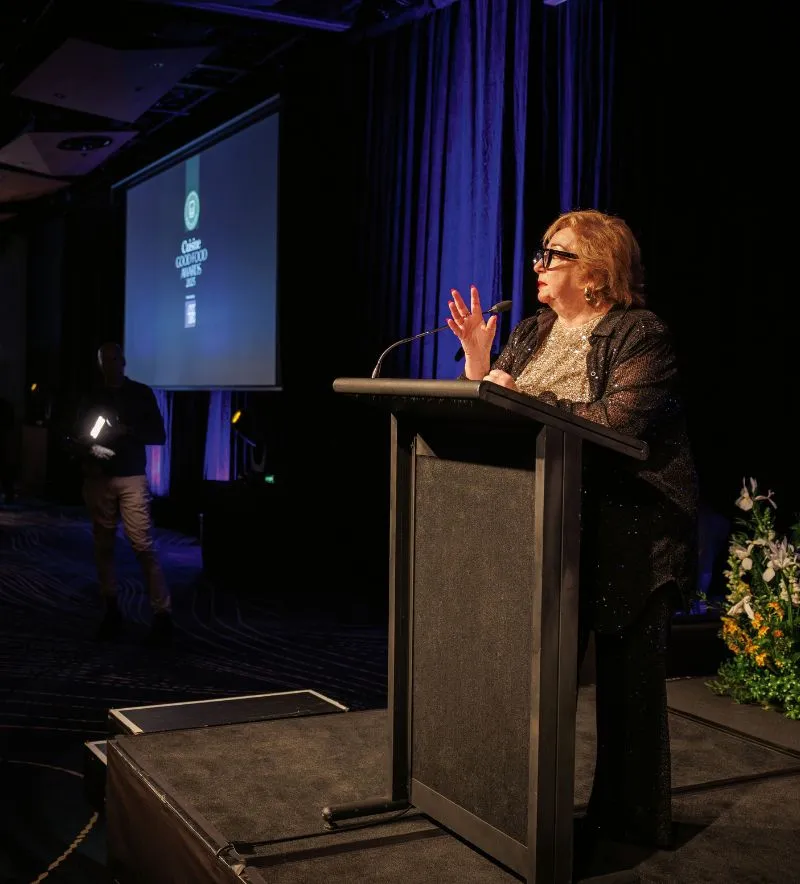
“We use our valuable platforms to tell people where to go. We are not here to tell people where not to go.” In an increasingly polarised digital culture, where outrage often drives engagement, that position feels distinctly intentional. Cuisine editor, Kelli Brett.
THE LIMITS OF JUDGING WHAT DINERS CANNOT SEE
Within hospitality circles, there is an increasingly common argument that restaurant judging should extend beyond the dining room. Conversations around sustainability, staff wellbeing, supplier ethics and workplace culture have become central to how modern hospitality is discussed. Many believe these elements should influence recognition. Cuisine acknowledges their importance, but also the practical limitations of assessing them fairly. “Our role is to assess the quality of the food and the experience,” Kelli explains. “The assessment team is trying to remain anonymous. Our team cannot go in and start asking questions about wages, staffing or internal practices.” There are also legal and logistical realities. Operators cannot always share employment information, and anonymous assessors cannot realistically verify internal systems or sustainability claims independently. Cuisine did attempt to introduce a sustainability category in previous years, but assessing it accurately proved difficult within an anonymous framework. “We can only go on the information provided by the restaurant,” says Kelli. “If we know about positive practices, we can give credit, but we do not always have access to that information.” Rather than abandoning the conversation entirely, Cuisine introduced the Champion for Change award category to recognise individuals actively pushing for better outcomes across sustainability, workplace culture and environmental responsibility.
Looking ahead, Kelli says the guide is also exploring ways for restaurants themselves to communicate their sustainability stories more directly. At the same time, she believes much of a restaurant’s internal health inevitably reveals itself in the dining room. “You can often sense the environment in a restaurant,” she says. “A healthy team and a positive atmosphere tend to come through in the dining experience.” It is a subtle but vitally important distinction. Cuisine is not positioning itself as an auditing body. Its role is to assess the experience delivered to diners while remaining conscious of the wider context shaping modern hospitality.
“Both an ultra-formal restaurant and a small casual space with a limited menu can be excellent in their own right. It comes down to how well they deliver what they promise and whether they deliver on that promise consistently.” Lead assessor, Kerry Tyack.

WHY TIMING MATTERS
One of the ongoing debates around restaurant reviewing is how soon new restaurants should be assessed. Visit too early and we risk judging a business before systems, staff and rhythms have settled. Wait too long and exceptional operators can miss opportunities for recognition during crucial early trading periods. Cuisine’s approach attempts to balance both realities. “We do not review a restaurant until it has been open for at least six to eight weeks,” Kelli explains. “You cannot assess consistency in the first few weeks and it is not fair to the team.” Like any choreographed production, new restaurants, or a new chef joining an existing restaurant, require a settling-in period. But once that initial phase has passed, strong performers are given the opportunity to be recognised early. This approach also reflects a broader philosophy underpinning the guide itself.
Cuisine is not interested in publishing takedowns. “We use our valuable platforms to tell people where to go,” Kelli says. “We are not here to tell people where not to go.” In an increasingly polarised digital culture, where outrage often drives engagement, that position feels distinctly intentional. The Cuisine Good Food Guide is designed as a trusted recommendation platform rather than a vehicle for public criticism. “If a restaurant is to be included, it must be worth visiting,” Kelli says. That does not mean public opinion is ignored. Social media feedback, audience conversations and broader diner sentiment all contribute to the overall picture that Cuisine builds throughout the year. But public commentary supplements professional assessment, rather than replacing it.
Ultimately, timing matters because restaurants are living, evolving businesses. A single dinner can never tell the whole story. What the Cuisine Good Food Awards attempt to measure is not perfection on one particular night, but the consistency, ambition and sense of care that reveal themselves over time. That requires patience, repeat observation and context – qualities that have become increasingly rare in a fast-moving food-media landscape. Yet they remain essential if a guide is to offer diners something more meaningful than simply another opinion.
For Cuisine, the responsibility is not only to recognise excellence, but to do so fairly, thoughtfully and with an understanding of the immense pressure under which modern hospitality operates. Because behind every hat sits a restaurant team striving to deliver something memorable, and a diner hoping to discover it.
A NATIONAL LENS
Every so often, questions surface around whether international benchmarks or external rating systems might shift the way New Zealand dining is evaluated, or even render local frameworks redundant. It’s a familiar narrative whenever global attention turns toward a smaller food culture, but it misunderstands what the Cuisine Good Food Guide is actually built to do and the fact that this global attention is, in part, a result of the work that we have consistently done to take our New Zealand food story to the world.
Cuisine has never positioned itself as a snapshot of only the most visible dining rooms in the country. Its remit has always been broader – deliberately so. It is not only about the allocation of hats. The guide includes restaurants across Aotearoa New Zealand, from major urban centres to regional destinations where some of the country’s most distinctive cooking is taking place. That national reach is not incidental; it is fundamental.
Equally important is context. Evaluating hospitality in New Zealand requires an understanding of scale, seasonality, supply chains, audience expectations and the cultural nuances that shape how people here eat out. These are not universal conditions; they are specific to this place. Cuisine’s strength lies in that specificity. The assessment process is grounded in a deep familiarity with Kiwi dining culture, how it has evolved, what diners value and the realities that operators work within. That lens cannot simply be imported or replicated by a global framework, no matter how rigorous its methodology may be. For Cuisine, relevance is about continuity, consistency and care over time. Since 1987, this publication has documented New Zealand’s food-and-dining landscape as it has shifted through generations of chefs, restaurants, influences and ideas. Those roles of observer, curator and recorder are what gives the guide its enduring authority – not because it defines New Zealand dining in a single moment, but because it has tracked its evolution for decades.
And that work continues with the same intent – to reflect the full breadth of the country’s dining scene, to understand it on its own terms, and to support the restaurants shaping its future.
SEE MORE FROM CUISINE
50 Years Of Sky High Hospitality
From caviar to conscious dining, Singapore Airlines celebrates half a…